
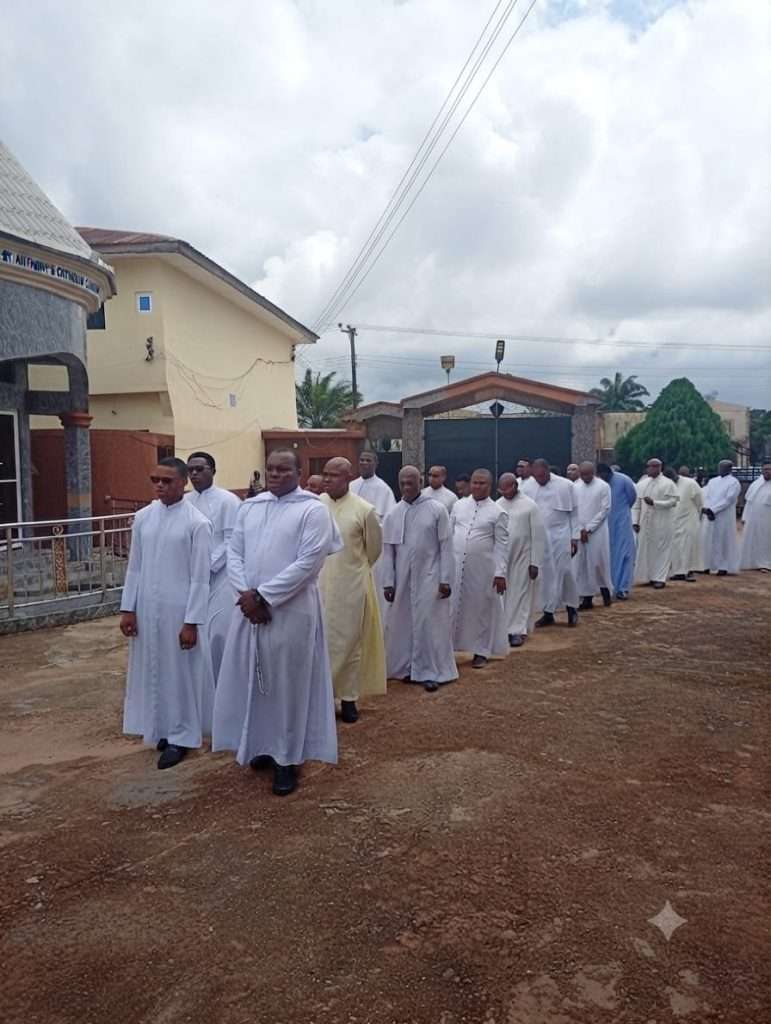
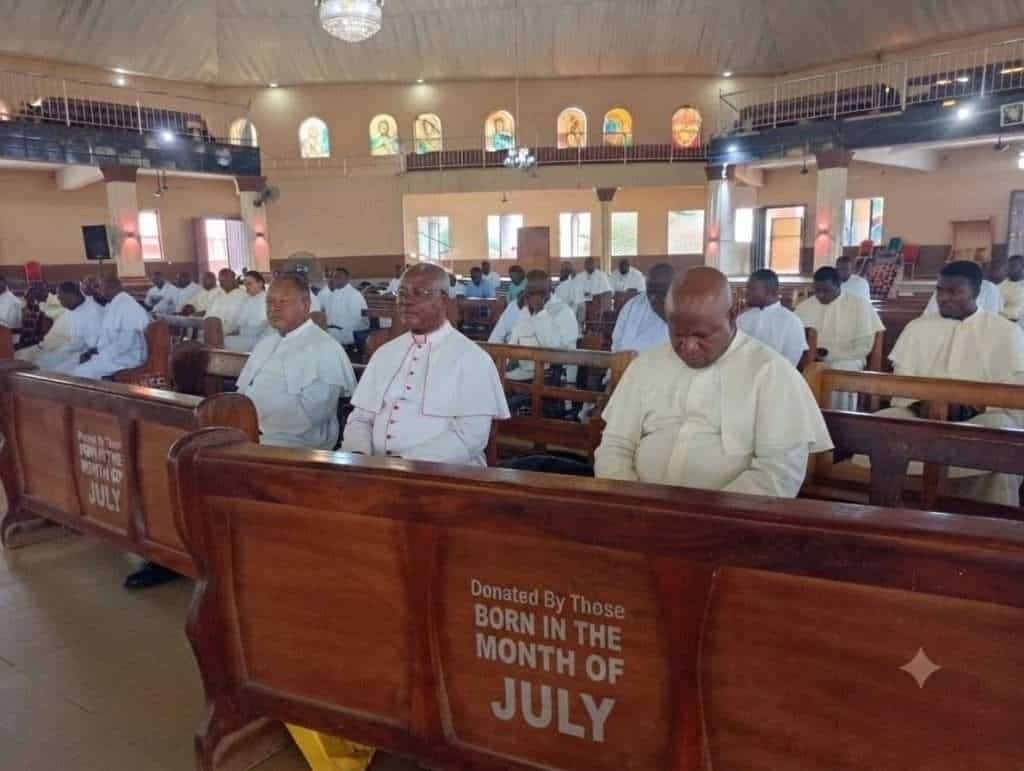
Between the hours of 9:00 a.m. and 1:00 p.m., priests serving within the Diocese gathered at St. Mary’s Parish, Umundugba, for their monthly recollection. The gathering was graciously hosted by the Parish Priest, Rev. Fr. Josephat Ndinojuo.
During the spiritual conference, Rev. Fr. Augustin Ifediba delivered a thought-provoking reflection on the theme: “The Stewardship of Service: Balancing Material Needs and Spiritual Calling.”
In his presentation, Fr. Ifediba emphasized that finance is a necessary component of a dignified human life and that material abundance is not inherently evil. Sacred Scripture and history attest that wealth, when properly utilized, can be a blessing. He cited biblical figures such as Abraham and Solomon, who were greatly blessed with material prosperity. Likewise, Peter, Paul, Matthew, Amos, and Elisha were all gainfully engaged in various occupations before their divine calling, yet they willingly prioritized their commitment to God above worldly pursuits.
He further recalled the example of the early Christian community, whose members demonstrated remarkable detachment by selling their possessions and placing the proceeds at the feet of the apostles for the good of the Church and the community.
The Challenge of Acquisition and Management
According to the speaker, the fundamental issue is not the possession of wealth itself, but rather the manner in which it is acquired, managed, and utilized. He pointed to Abraham as a model of prudent stewardship, noting that despite his wealth, he never allowed material possessions to become a source of conflict with his nephew, Lot.
Fr. Ifediba acknowledged the genuine financial responsibilities faced by priests today, including diocesan obligations, family commitments, social responsibilities, and personal needs. Nevertheless, he stressed the importance of exercising prudence, transparency, and moderation in financial matters. He reminded the priests that even the apostolic college maintained order through the appointment of a treasurer.
Drawing attention to the diocesan context, he highlighted the importance of fraternal charity, citing the care extended to sick priests and the support provided through the Domus Clero. He encouraged the clergy to continue living out the Igbo maxim: Onye aghala nwanne ya—”Let no one abandon his brother.”
Guarding Against the Love of Money
Fr. Ifediba warned against allowing financial considerations to overshadow priestly identity and mission. Echoing the words of Christ, he reminded the clergy that one cannot serve both God and mammon. He cautioned against measuring pastoral success solely by material returns or financial achievements.
Referring to the exhortation of St. Peter, he emphasized that priests are called to shepherd God’s flock not for “sordid gain,” recalling that the Latin term sordida conveys the notion of dishonorable or impure profit. The ultimate criterion for evaluating priestly ministry, he noted, remains the salvation of souls: Salus animarum suprema lex—”The salvation of souls is the supreme law.”
He also cautioned against becoming dependent on or manipulated by wealthy individuals, affirming that no priest in the Diocese of Orlu lives in absolute destitution. Rather, priests should cultivate the spirit of contentment and detachment exemplified by biblical figures such as Elisha, Peter, and others who willingly renounced worldly gain for the sake of God’s kingdom.
A Call to Humility Among the Clergy
Addressing newly ordained and younger priests in particular, Fr. Ifediba underscored the importance of embracing humble beginnings. He warned against the temptation to compare oneself with older confreres, observing that comparison often becomes a source of dissatisfaction and unhappiness.
He recalled the example of Aaron, who possessed no earthly inheritance because the Lord Himself was his portion. In the same spirit, he encouraged priests to find their deepest joy not in material possessions, but in their identity as priests of the Most High God.
Drawing from the teaching of St. Thomas Aquinas, he reflected on the sublime dignity of the priesthood, noting that priests have been entrusted with the power of consecration—a privilege not granted even to the angels. Consequently, if Christ Himself is not sufficient for us, no amount of material acquisition will ever satisfy the human heart.
He concluded by exhorting the clergy to live lives marked by contentment, detachment, gratitude, and faithful stewardship, always remembering that our true worth lies not in what we possess, but in who we are in God.
May Our Lord Jesus Christ grant us the grace to use all that He has entrusted to us for the glory of His Church and the service of His people.
